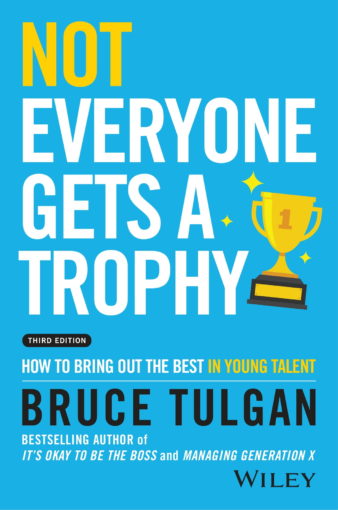
NOT EVERYONE GETS A TROPHY: HOW TO MANAGE GENERATION Y book
There are few bright sides to the likely prospect of a prolonged economic downturn. Here's one: This might be the perfect time for business leaders, managers, and other "grown-ups" to give a much needed reality check to Generation Y employees (those born 1978 and later).
What is the reality check today's young workers need to hear? "Not everyone gets a trophy!" according to Bruce Tulgan. That is the title of his new book, NOT EVERYONE GETS A TROPHY: How to Manage Generation Y (Jossey-Bass, March 2009, $24.95).
Based on more than a decade of research, Tulgan's message is simple: "Generation Y calls for strong leadership, not weak."
Back in 1995, Tulgan's first book, the classic MANAGING GENERATION X, radically changed the way young people in the workplace were viewed. Tulgan has been studying young workers ever since.
In NOT EVERYONE GETS A TROPHY, Tulgan writes, "Generation Y has been
much analyzed but largely misunderstood. Most 'experts' are simply
reinforcing prevailing misconceptions about Generation Y." Tulgan then goes
on to debunk what he calls "the top fourteen myths about Generation Y in
the workplace," including these:
Myth #1: Gen Yers are disloyal.
Myth #2: They won't do the grunt work.
Myth #5: They need work to be fun.
Myth #10: Money is the only thing that matters to them.
Myth #11: They don't respect their elders.
Myth #12: They want to learn only from computers.
Tulgan declares, "GenYers don't need to be humored in the workplace. They need to be taken seriously. Managers need to hold them to high standards and help them every step of the way to reach those high standards."
Tulgan's research shows that most of the so-called 'experts' on Generation Y have been leading managers in the wrong direction. In so many recent books and articles, these 'experts' have argued that the key to recruiting, retaining, and managing this generation is to somehow make the workplace more 'fun.' Because GenYers have grown up with self-esteem-based parenting, teaching, and counseling, these 'experts' have argued, the right way to manage GenYers is to focus on praising and rewarding them. Some companies, following such advice, have actually instituted programs to deliver 'thank-you' notes to GenY employees just for showing up to work on time. Others are turning recruiting into one long sales pitch; transforming the workplace into a veritable playground; rearranging training so it revolves around interactive computer gaming; encouraging young workers to find a 'best friend' at work; and teaching managers to soft-pedal their authority.
Tulgan insists, "This approach is all wrong and totally out of touch with reality, especially right now in these hard economic times."
Tulgan offers a real world approach that is a clear departure from most
everything previously written on the subject. Tulgan says, "My approach
takes much less from the likes of GOOGLE and a lot more from the Army and
the Marine Corps." Tulgan urges managers of Generation Y employees:
-NEVER undermine your own authority;
-NEVER pretend that the job is going to be more fun than it is;
-NEVER suggest that things are up to GenYers when they are not;
-NEVER gloss over details;
-NEVER let problems slide;
-NEVER offer praise or rewards for less than excellent performance.
Tulgan's strong-management message may seem especially timely given today's economic hard times, but it is the same message he's been delivering for several years behind closed doors with leaders in hundreds of organizations across the private and public sectors. Tulgan's clients in the last few years alone range from insurance giant Aetna to Wal-Mart; from Applebee's to the YMCA; from the United States Army and the CIA to the United States Peace Corps.
Based on his work with these and many other world-class organizations, Tulgan shares dozens of compelling and funny first-hand stories featuring poignant quotes from GenYers and those who manage them, putting the two perspectives in conversation throughout the book. Along the way, Tulgan lays out a catalogue of step-by-step best practices for engaging, developing, managing, and retaining Generation Y employees.
While this book is written primarily for those who manage Generation Y, it will be of special interest also to parents of Generation Y. Funny enough, the managers and parents are often the same people. The irony is that the devoted helicopter parents of GenYers often go to work and quickly become the outraged managers and co-workers of GenY employees. In a chapter entitiled, "In Loco Parentis Management," Tulgan writes, "You can't fight the over-parenting phenomenon, so run with it. In the workplace, there is a void where their parents have always been. Step into the void."
Indeed, Tulgan's recipe for success with Generation Y often sounds a lot like parenting. He urges managers to give GenYers boundaries and structure, negotiate special rewards in very small increments, teach them how to manage themselves, and teach them how to be managed.
What is the ultimate prognosis? Tulgan writes, "Generation Y is the most high-maintenance workforce in history, but they also have the potential to be the most high-performing if they are managed the right way."
192 pp / Hardcover / Jossey-Bass, March 9, 2009 / $24.95
• Place an online order for the book
• Text from the book jacket
• Praise for the book
• An excerpt from the book (Chapter 1)
• Q&A with the author, Bruce Tulgan
• The top 14 myths about Generation Y
• The seven types of jobs for Generation Y
• The eight self-building factors for Generation Y

Bruce Tulgan's recent best-seller,
Bruce Tulgan's new book,